

An Introduction
Written by Joanna Arteaga Ferrín
Preface
My name is Joanna Arteaga Ferrín. I am Latina, and the first-generation born in the United States. I have a degree in Museum & Curatorial Studies, with minors in Art History, History and Anthropology, and a degree in Commercial Art (Illustration). My research and primary field(s) of focus are Latine/x memory and identity, Latine/x and Latin American art and history, decolonization, and curatorial activism.
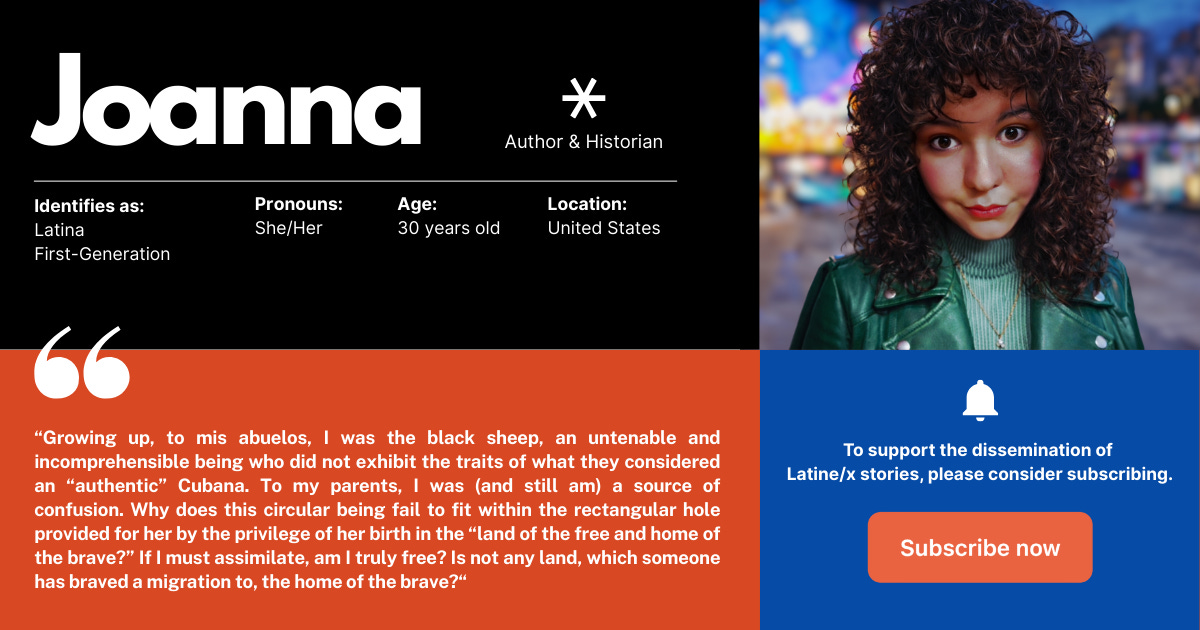
I wanted to introduce myself, as this project is one that cannot be fully seperated from myself as the researcher and writer. The title, Interpreting Self, is both a reflection and a guide. I began this project with a line of questioning pertaining to my own identity and trying to interpret it in the United States as someone who toes the line of two worlds, a Latina born and raised here, and a child of immigrants. As the project turned into a fully realized thesis and the political climate began targeting Latine/x communities in a more emboldened way, I knew this project had to be made public. The project had to be expanded into a space where Latine/x voices could be lifted above the rhetoric and these human stories of migration, assimilation, liminality could be healing, cathartic, and show the complexities of identity through their dissemination.
The overarching goal of Interpreting Self is rooted in expanding the academic tradition through the notion of epistemology, focusing on how the tangibility of shared experience through visual language and oral history is one that has emotional currents that demonstrate a quantum entanglement beyond “objective knowledge.” This is the space in which both participant, maker, and audience can co-exist; it is not necessary to make one within your own image, for these are not projects of transmutation, but instead ones of solidarity without the pretense of your perceived norms.1
Introduction
Interpreting Self: A Latine/x Public History Archive begins with a simple concept: that memories embody not only archives of feeling, but are also instruments of resistance. To record and recount remembrance is to refuse erasure. It is an act of reclamation and a claim to define how we are seen. This project began as a university thesis, harnessing these concepts, and now taking on life through three interwoven facets. First, through a practice in portraiture of the participants of this project. The portraits are co-authored by me as the artist and the participants who set the standards of aesthetic representation through color, iconography, and imagery. Second, a limited-edition catalog was developed as the final thesis submission. Finally, the former are brought together in a public history archive showcasing both the co-authored portraits and the participants’ oral accounts, which are focused on three categories of experience: Migration, Assimilation, and Liminality. This public history archive is anchored in curatorially activist ethics and made accessible to the public.
In this project, I utilize the labeling “Latine/x-American” as an umbrella terminology to align with the academic verbiage used when referring to communities of Hispanic or Latino descent. It must be clarified that the labels “Latinx” and “Latine” are, in themselves, controversial within these communities. One of the core practices within this project is the agency of self-identification, for each participant to define and identify themselves with their preferred labels, which are reflected within their oral accounts. The label “Latine/x-American” in this project acts in a way to not reduce these self-identifiers. It aims to remain a) inclusive of all racial and ethnic self-identifications, b) free from the social constructions of gender, and c) separate itself from hierarchical categorizations subconsciously made by biases in regards to the former. I do choose to include the hyphen, as it reflects the identifications often made within socio-cultural and political norms, such as Hispano-Americans, African-American, Asian-American, and so forth.
The term “hyphenated American” was used derogatorily in the early 1900s, particularly centered around German-Americans during World War I, with both Theodore Roosevelt and Woodrow Wilson taking hard stances on how hyphenated Americans were “not good Americans,”2 nor could they be trusted.3 In turn, the hyphen has served as both a tool for “othering” and marginalization, and as a space for self-identification.
I undertake this project as a first-generation U.S.-born Latina (my own chosen identifier) from Generation Y (also known as Millennials), accountable to my community and my own contradictions and complexities. I write as an ethnographer and artist, curator and subject. The hyphen of Latine/x-American is not a delimiter, but a site of a method in this project, serving as a hinge to move the lines forward.
I began this process as an introspection of my own understanding of my identity. I am the daughter of immigrants who grew up hearing the stories of a place I will probably never see, breathe in, or touch. Cuba was always an abstract concept, one that felt like what I imagine people who describe knowing their past lives must feel. It’s a question: What would my life be like if my family had never made the journey? Who who I be? It has also represented the borderlands I carry within myself. Ni de aquí, ni de allá.4 I am a multitude, and I am the in-between. In Sanskrit, the word antevasin means “one who lives at the border,” and when I discovered it a few years ago, I heard it echo inside of me. I hold within me the lives of all those who came before, yet I do not dwell in those same dimensions, nor do I fit within the bounds of the standard Americana.
Growing up, to mis abuelos, I was the black sheep, an untenable and incomprehensible being who did not exhibit the traits of what they considered an “authentic” Cubana. To my parents, I was (and still am) a source of confusion. Why does this circular being fail to fit within the rectangular hole provided for her by the privilege of her birth in the “land of the free and home of the brave?” If I must assimilate, am I truly free? Is not any land, which someone has braved a migration to, the home of the brave? While my parents view assimilation as the way to exist and truly be an American,5 I choose to wave my flag of Latinidad as a battle cry. Pero this was not the identity I was supposed to take on as the first generation; I was supposed to be the flag bearer for this version of the red, white, and blue.
This project and its practices are part of a constantly growing understanding, and it is further fed by the frustration of the reductive scripts that flatten voices and lives into a handful of tropes. Within my own life, I have found that I unconsciously place myself within boxes of reductive narratives because they are socially or culturally considered normal expressions of identity. But these are not neutral scripts within our landscapes. They are misidentifiers in that, in order to have unity, there must first be a reduction or subtraction of parts to reach the final whole.6 They are produced and circulated within social, cultural, and political spheres that have long been extracted from Latine/x and Latin American communities, while simultaneously denying us the authority to narrate our own stories and representations for ourselves.
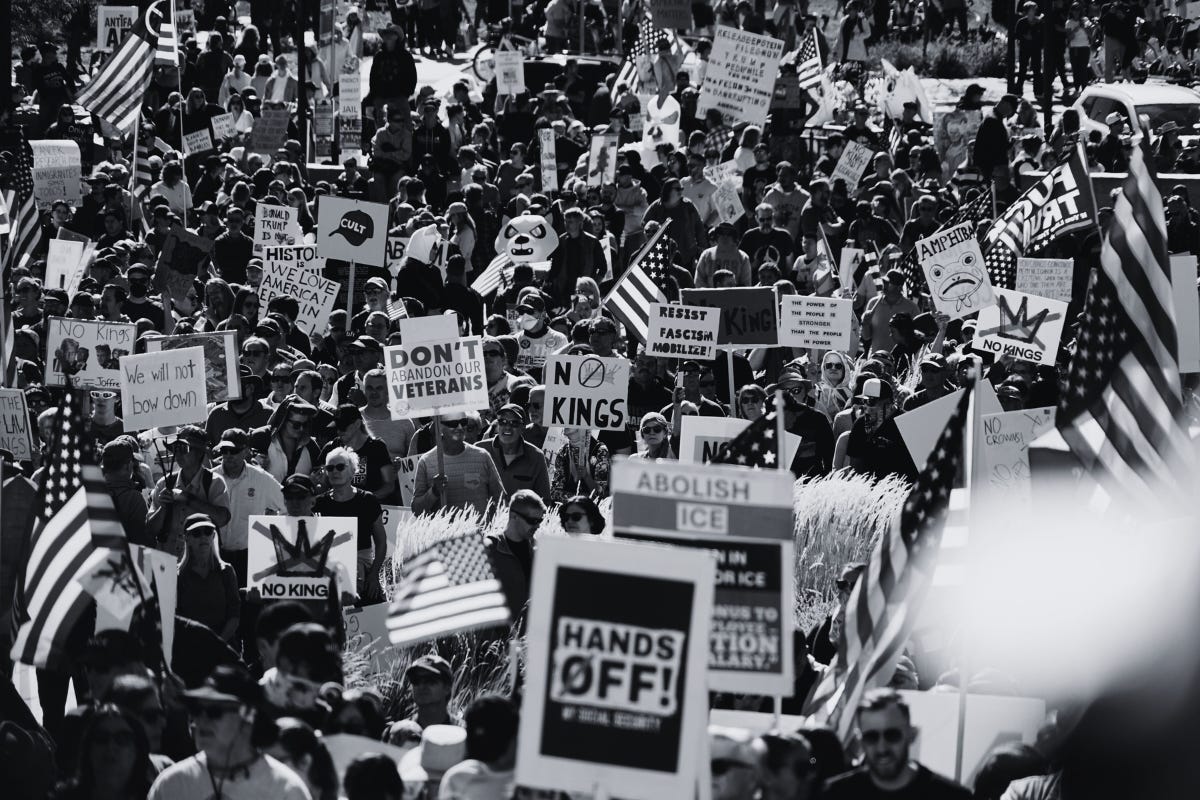
The current socio-political climate within the United States is marked by instrumentalizing Latine/x-American communities as data points in the calculations of power, intensified border enforcement,7 expanding infrastructures of detainment and criminalization,8 a lack of due process,9 scapegoating through racist and discriminatory language and depiction,10 volatile legislation11 and policies,12 removing constitutional freedoms via Supreme Court decisions,13 and working to distract from the broader implications of class conciousness by placing blame on Latine/x-Americans and other marginalized communities, which historically, have no had the distributive power to create the problems they’re being blamed for. In juxtaposition to this, I aim to recenter lived experience and human complexity through this project through co-authored visual representation rooted in curatorial activist principles, and oral accounts, which act as an archive of memory and resistance by allowing for self-identification and narration.
Our stories are not deficits to be overcome, but epistemologies; ways of knowing the world otherwise, and whether acknowledged by Americans or not, have become part of the United States’ “social and psychic landscape.”14 My considerations of these landscapes also look at the intersections of African-American and Latine/x-American histories in the United States, as we see entwined insurgencies against empire and racial capitalism; reading those histories together dislodges myths of isolated struggle and surfaces a tradition of cross-racial and ethnic solidarity.15 These intersections are heavily present within the Afro-Latine/x experience, which is an even further marginalized representation within the broader contexts of Latine/x-American landscapes of experience. Indigenous perspectives are also heavily considered, as Latine/x-American and Indigenous identities can often be synonymous when understanding that often those who are deemed “alien” by systems of authority are, in fact, Indigenous to the American landscape. The art historical canon has also positioned Latin American and Latine/x production as derivative, a mimicry, or as “belated modernity,” which is a misrecognition rooted in colonial hierarchies of value.16 Cardoso’s argument that decolonization is not a metaphor, but a material rebalancing of who is allowed to keep, guard, and expand the canonical17 is the lens through which I base my curatorial perspective. This project, in its entirety, is a site for redress and reclamation, rather than commentaries of exclusion.
In experiencing these practices, I urge you to step outside of the echo chambers of division that aim to redistrict your critical understanding. Expand your horizons beyond a limited scope of human existence, and instead lend your mind to multiplicity.
A Note on Preservation: We believe the power of an oral history lies in the unique voice of the storyteller. To honor this, we have chosen to leave the grammar and flow of the oral history submissions exactly as they were received. Aside from correcting obvious and severe misspellings, no editorial changes have been made. Our goal is to protect the sanctity of the original writing and provide you with an unfiltered connection to the contributor’s experience.
Disclaimer: This work is written by humans for humans. No generative artificial intelligence (AI) was used in the writing of this work. The author expressly prohibits any entity from using this publication for purposes of AI technologies to generate text, including, without limitation, technologies that are capable of generating works in the same style or genre as this publication. The author reserves all rights to Interpreting Self: A Collection of Contemporary Oral Histories Exploring Generational Latine/x-American Identity & Narrative and its various interations and forms of publication, exhibition, and display.
To view more stories by Latine/x-Americans, please visit the Oral Histories page, which will have new stories posted regularly.
To share your story with this project, in which you can choose to remain anonymous, please visit the Share Your Story page.
To learn more about this project, please visit An Introduction.
To learn more about the sources of this project and the research gap it aims to bridge, please visit the Literature Review page.
© 2026 Joanna Arteaga Ferrin. All rights reserved.
Édouard Glissant, “For Opacity,” essay, in Poetics of Relation (London, UK: Penguin Books, 1990), 193.
“Roosevelt Bars the Hyphenated” (PDF). New York Times. October 13, 1915. Archived (PDF) from the original on April 4, 2021. Retrieved June 13, 2018.
Di Nunzio, Mario R., ed. (2006). Woodrow Wilson: Essential Writings and Speeches of the Scholar-President. NYU Press. 412.
We can see this phrase utilized in Facundo Cabral’s song No soy de aquí ni soy de allá as well as the articulations of borderland spaces mentally, emotionally, politically, and physically within Gloria Anzaldúa’s work Borderlands/La Frontera: The New Mestiza (1987). The phrasing has become popular in describing the liminal spaces in which Latine/x-American communities occupy when navigating within the United States.
I don’t condemn my parents for their views on this topic. I understand that I have had the privilege to exist in a space that has, in many ways, been established for me. My parents came here from Cuba as immigrants, and their lived experience is less rooted than mine. The criticisms of the United States that I express come from a person who was born and raised in this country, and yet was still made to feel “othered.” I grew up hearing the sentiments of “liberty and justice for all” and “treat others the way you would want to be treated,” and I expected this to be the truth. I demand more. I believe that humanity can be better, and I won’t settle for less than that. My parents, on the other hand, grew up with “other” as an expectation; therefore, the only way to counter it was to make sure they did not rock the boat. When they arrived in the United States, their parents were met with signs that said, “No Cubans allowed,” or “We don’t rent to Cubans.” Their natural decision was to assimilate has come with its own set of complications. They have a lot of internalized colonialism, and in the case of my father, denial and an expressed hatred towards his own heritage. My own choice to be vocal and proud has come with the complications of “othering” myself and putting myself in the direct path of many racists. The point here, from my perspective, is that neither should be the outcome; you should not have to choose between perceived assimilation or being “othered.” I use the term “perceived assimilation” because, despite the efforts of my parents and many others I know, to adopt the “standards of White America,” Latine/x-Americans who attempt to assimilate are still met with the harsh realities of discrimination, racism, and “othering.” Gayatri Chakravorty Spivak, in their work An Aesthetic Education in the Era of Globalization (2012), refers to this concept as the “double-bind,” where conflicting requirements make it an impossible task to respond correctly.
Glissant, “For Opacity,” 192.
“Protecting the American People Against Invasion,” The White House, 2025, https://www.whitehouse.gov/presidential-actions/2025/01/protecting-the-american-people-against-invasion/.
Richard Fausset, “Jokey Names for Detention Centers Face Criticism for Insensitivity - The New York Times,” The New York Times, August 26, 2025, https://www.nytimes.com/2025/08/26/us/immigration-detention-center-nickname-alligator-cornhusker-slammer.html.
Abbie VanSickle and Alan Feuer, “Federal Courts Buck Trump Deportation Schemes, Focusing on Due Process Rights - The New York Times,” The New York Times, May 17, 2025, https://www.nytimes.com/2025/05/17/us/politics/courts-immigrants-venezuelans-garcia-trump.html.
“Mass Deportation: Analyzing the Trump Administration’s Attacks on Immigrants, Democracy, and America,” American Immigration Council, July 28, 2025, https://www.americanimmigrationcouncil.org/report/mass-deportation-trump-democracy/.
Priscilla Alvarez and Michael Williams, “Facing Pressure from All Sides, ICE Gets a Windfall of Cash to Ramp up Enforcement | CNN Politics,” CNN, July 20, 2025, https://www.cnn.com/2025/07/20/politics/immigration-enforcement-deportations-budget.
Ben D’Avanzo, Tanya Broder, and Heidi Altman, “The Anti-Immigrant Policies in Trump’s Final ‘Big Beautiful Bill,’ Explained - NILC,” National Immigration Law Center, August 20, 2025, https://www.nilc.org/resources/the-anti-immigrant-policies-in-trumps-final-big-beautiful-bill-explained/.
Adam Liptak, “Supreme Court Lifts Restrictions on L.A. Immigration Stops - The New York Times,” The New York Times, September 8, 2025, https://www.nytimes.com/2025/09/08/us/politics/supreme-court-los-angeles-immigration.html.
Hector Tobar, Our Migrant Souls: A Meditation on Race and the Meanings and Myths of “Latino” (New York, NY: Farrar, Straus and Giroux, 2023), 38.
Paul Ortiz, An African American and Latinx History of the United States (Boston, MA: Beacon Press, 2018).
Rafael Cardoso, “Decolonizing the Canon?,” Texte Zur Kunst, no. 128 (December 2022), 101.
Ibid
Thanks for writing this, it clarifies alot. This intro makes so much sense after seeing your work on Interpreting Self. It's a truly important and powerful project.