
"I sometimes feel like an imposter, like I take up space in an identity group I don’t actually belong to..."
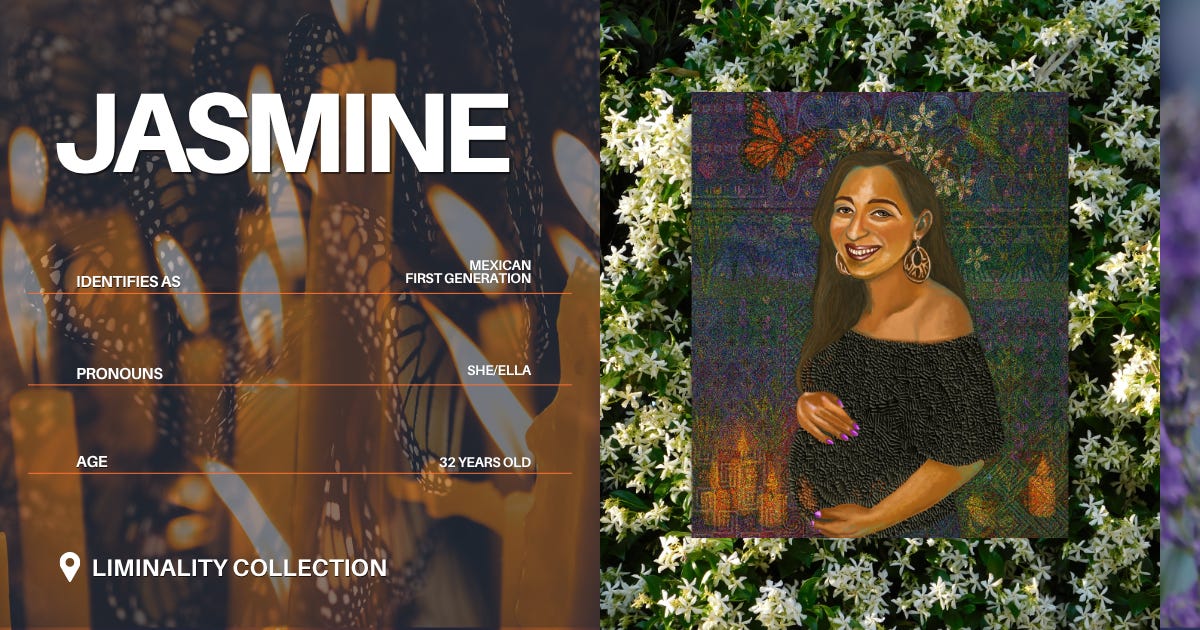
Meet Jasmine (She/Ella) a first generation Mexicana who speaks on her experience on the pressure of liminal spaces regarding her identity.
A Note on Preservation: We believe the power of an oral history lies in the unique voice of the storyteller. To honor this, we have chosen to leave the grammar and flow of these submissions exactly as they were received. Aside from correcting obvious and severe misspellings, no editorial changes have been made. Our goal is to protect the sanctity of the original writing and provide you with an unfiltered connection to the contributor’s experience.
A Note on Opinions: The views and opinions expressed in this story are those of the speakers and do not necessarily reflect the views or positions of any entities. These are human stories from differing perspectives and experiences. As the reader, you have the right to disagree with the views and opinions expressed. This project is focused on shared humanity, the power of memory, and creating a space of healing and agency for participants.
“I usually identify as Mexican. My mother is from Mexico, and my dad is white. I grew up steeped in white culture in rural Appalachia and had to actively seek out a connection to my Mexican heritage. We lived far from my mom’s family, so I didn’t see them much. My mom didn’t include a lot of Mexican heritage in our home or customs. My parents decided not to teach us Spanish so we wouldn’t have an accent (eye roll) and because my dad didn’t speak it (double eye roll).
Because of the effort I put into building my own connection to my Mexican heritage, I choose to use Mexican in conversation, or Mexican American when completing forms. I don’t mark white on forms because that feels like a complete erasure of my Mexican side. I usually mark ‘other’ or ‘multiracial.’
At the same time, I’m very aware of the privilege I carry being half white and white-passing, and I haven’t quite figured out how to fit into these categories. It really feels like the categories should change to accommodate real people with complex heritages.
I usually say I’m first generation, even though my mom was born in Mexico and I was born in Wisconsin. When she came to the U.S., her family moved to Miami, and that’s where she was raised. She was able to speak Spanish and continue to center her culture without societal pressure to conform, since everyone in her section of Miami neighborhoods were immigrants and Latinx too. When she met my dad and moved north (eventually to West Virginia), all that changed in how she raised us. It was like she cut off her Mexican identity to better fit with him, the life he envisioned, and the environment.
My dad never truly embraced our culture, besides liking the food or finding my mom attractive. He never learned Spanish, never learned customs or holidays, never verbalized respect for the culture and importance of traditions, and never prioritized spending time with our family from her side. It was strongly implied that my mom’s side was ‘less than,’ troublemakers, and not as worthy of our time and effort, whereas his side we saw for almost every holiday, despite it being an eight-hour car ride. To this day, he considers my brother and me white and rolls his eyes or disagrees when I affirm that I am Mexican or brown.
His attitudes made it hard to feel connected to being Mexican, and I was ashamed of this identity for a long time. No one else in my elementary school was brown, so they bullied me, and I started to hide my identity, but something was always missing. In college, I was surrounded by more diversity, and I immediately gravitated to learning more about the history and complexities of my Mexican culture, Latin America as a whole, and what it all means for me personally. These connections saved me from the constant disconnect I felt of not belonging. I love being Mexican and embracing my heritage. I love being Latina and bonding with other BIPOC folks.
Growing up in a very rural area without many other BIPOC people was really hard, and I like connecting with others who had that experience.
At the same time, I wonder if I have the right to claim such strong roots when I’m ‘only half’ Mexican, and I appear racially ambiguous but more white-passing, I don’t speak Spanish well and it’s accented, and I sometimes feel like an imposter, like I take up space in an identity group I don’t actually belong to, because both my parents aren’t brown or immigrants and I was ‘raised to be white.’
My mom was told she needed to assimilate and be the best American, and I think she carried that mindset into how she raised us, so we could have the best chance at success. It’s so hardwired in her that when we talk about it today, she pauses when I say I’m Mexican. She doesn’t contradict me, but she doesn’t seem to fully support that I embrace this identity and continue to seek out avenues of connection with it. She seems torn about it, but never says anything outright, the way my dad will.
One of my happiest memories is from college, when a professor pulled me aside after class and told me about the new Latin American Studies major. I immediately met with the advisor of the program, joined, and immersed myself in learning. I was exploring my heritage and identity while understanding complex systems that exist throughout Latin America and the U.S. and impact folks on an individual level. I felt embraced; my identity was celebrated and respected without contradiction, and I couldn’t get enough of that. I loved being in those spaces and meeting other Latine people who were just as excited to be around other Latines as I was.
There are painful memories, too. I had been dating a white man for several years, and we had bought a house together. I think my father thought we would get married. He saw a lot of himself in this guy, and I did too, which is why I ultimately couldn’t stay with him. He told me that he ‘didn’t see me as Latina,’ and I knew I would live the same half-life as my mother. I refused to give up my identity to fit with him. My dad was upset about our breakup and couldn’t understand that I didn’t feel loved by someone who saw me as white. He responded that I am white, and I felt so unseen and hurt.
I really wish I knew the story of my family’s migration. My mom won’t speak about it at all. My tía told me that they moved from Mexico because my abuela missed her family, who were already here, and wanted to be with them, so my grandfather agreed, and they moved to Miami. I don’t know if this is the truth or what actually happened. My aunt won’t ask my grandfather about it. He only speaks Spanish, and any time I try to talk to him in Spanish, he tells me I don’t speak Spanish and rolls his eyes. We’ve never had a conversation, let alone the opportunity for me to interview him about the experience. I really wish I knew more about it, and I’m scared that when he passes, a huge chunk of family history will be lost.
It seems like their migration came with required silence. My mother, growing up, needed to be American, and that was it. She could be Mexican in the home but not outside of it. My parents also struggle with substance abuse and have since I was about nine. Any questions or conversations about identity are almost always occurring when they aren’t sober. I can’t get much history or anything from my mom because of her substance misuse. Most of the history I have is from my aunt. But my mom is the oldest and probably the only one that actually remembers, since she was about eight or nine when they moved here.
I don’t doubt that the intense trauma of migration and assimilation, relocation after marrying my dad, and the violent passing of her own mother (a firearm accident in the home) contribute significantly to her substance misuse. But we don’t talk about it, or anything, really, so I don’t know. For me, it is a strong cutoff from the heritage, and I am forced to find connections to it on my own.
I wish I knew more about the history of my family and why my culture was hidden from me. I love being Mexican, and I wish my mom could feel that love in embracing who she is. My aunt, who lives in San Antonio and married a Mexican man, seems so much more at peace. They speak Spanish together and celebrate holidays and traditions. There’s still machismo they navigate with his parenting, but they connect on culture. I met my husband while staying with my aunt during COVID, and I’ve never felt more connected to my true self than when I lived there. We are constantly embracing our shared Mexican culture.
When I think about words like ‘immigrant,’ ‘migrant,’ ‘alien,’ all of it just feels gross. I can’t quite pinpoint what about it bothers me, but it feels like a way to emphasize otherness. It bothers me that this is a priority in identifying people when there is a complete erasure of the inherent otherness of everyone who isn’t Indigenous to this land. Everyone who isn’t Indigenous to the U.S. is an immigrant or migrant or whatever term they came up with. So why force some of us to hold these labels when everyone else should too? What’s the point of this separation?
I know that it’s so, politically, people can be marginalized based on classification, but it’s all bullshit.”
Disclaimer: This work is written by humans for humans. No generative artificial intelligence (AI) was used in the writing of this work. The author expressly prohibits any entity from using this publication for purposes of AI technologies to generate text, including, without limitation, technologies that are capable of generating works in the same style or genre as this publication. The author reserves all rights to Interpreting Self: A Collection of Contemporary Oral Histories Exploring Generational Latine/x-American Identity & Narrative and its various interations and forms of publication, exhibition, and display.
To view more stories by Latine/x-Americans, please visit the Oral Histories page, which will have new stories posted regularly.
To share your story with this project, in which you can choose to remain anonymous, please visit the Share Your Story page.
To learn more about this project, please visit An Introduction.
To learn more about the sources of this project and the research gap it aims to bridge, please visit the Literature Review page.
© 2026 Joanna Arteaga Ferrin. All rights reserved.