

Literature Review
Sources cited and consulted include works of popular press literature, and a mixture of peer-reviewed articles, museum and archival case studies, art historical essays, manifestos, and more.
The process of the research cited and consulted within Interpreting Self is a synthesis of (a) scholarship on identity development and generational formation; (b) oral history and community archive practices; (c) curatorial activism, Global South art genealogies, and decolonial debates; and (d) crossover literature that reframes the Latine/x-American experience for the broader public. Sources cited and consulted include six works of popular press literature, and a mixture of eighty peer-reviewed articles, museum and archival case studies, art historical essays, manifestos, and curatorial texts.
Section I. Identity as a Developmental & Situated Practice
Work on labels and categorization shows that terms like “Hispanic,” “Latino/a,” “Latinx/Latine,” and “Latino/a-American” are not neutral descriptors, but negotiated positions shaped by racialization, policy, and community practice. Oboler highlights contested approaches to Latine/x identity formation.1 Golash-Boza’s analysis of “dropping the hyphen” shows how the United States’ racialization processes pull people toward an Americanized identity, even as specificity persists.2 Glissant’s examination of the West’s interventions on identity demands “the right to opacity” by displacing structures of reduction and moving towards participatory entanglements that allow for opacities to co-exist, converge, and weave together.3 In combination, these works argue for treating labels as questions under revision, not as frozen variables, and modalities of understanding as things that can be revolutionized.
Developmental frameworks complement these views. King and Baxter Magolda propose intercultural maturity as a coordinated growth of cognitive, intrapersonal, and interpersonal capacities,4 while Torres and Baxter Magolda show how Latine/x college students reconstruct identity through shifting meaning and making structures.5 Archuleta and Lakhwani connect acculturation, emotional regulation, and depressive symptoms among first-generation youth;6 Potochnick and Perreira identify correlations between anxiety and depression among first-generation immigrant Latine/x youth, underscoring structural stressors.7 These studies justify the project’s emphasis on oral histories that can hold change over time.
Family and household contexts shape these arcs as Landale, Thomas, and Van Hook analyze living arrangements of children of immigrant parents;8 Domenech Rodriguez et al. describe culturally specific protective parenting styles;9 Roche et al. examine cultural orientations and parental beliefs as they relate to autonomy.10 Benito-Gomez updates the parenting conversation for the 21st century.11 These threads help interpret participants’ intergenerational narratives without defaulting to deficit framings.
Generational locations also matter in these contexts. The Pew Research Center’s typology of Generational Differences provides a pragmatic understanding of situating a Generation Y (Millennial) researcher and participants within broader United States cohorts.12 This is a reminder that identity formation is co-produced by age-related media, schooling, and the contexts of policy. Where prior studies tend to analyze labels and trajectories, this project co-authors them. Participants self-identify both visually and categorically, turning naming into a material practice of self-definition and determination. This is method as an intervention, not merely inclusion.
Section II. Memory as Resistance
Community archives demonstrate how memory can be operative, not merely illustrative. Curtis shows how Afro-Latinidad is made visible (and in many cases sidelined) in major museum spaces.13 In cultural politics, Hughes and Dalla Dea frame Latin American art activism as a practice of authenticity and resistance;14 Saunders maps Afro-Latine/x countercultures;15 Villenas connects diaspora to educational anthropology and community knowledge.16
A broader activist aesthetic emerges in studies of transborder art and youth agency through Aushana, connecting the artscapes at the United States and Mexican border as forms of resistance;17 Cammarota traces gendered and racialized pathways of struggle among Latine/x youth;18 Velez, Perez Huber, and Benavides analyze youth media activism amid anti-immigrant sentiment;19 hooks and Mesa-Brains imagine homegrown criticism rooted in community practice.20 These works model how memory, art, and pedagogy circulate to build collective agency.
Many projects collect oral histories but hold the visual decisions in curatorial hands. Here, testimonies generate the brief for portraits and the exhibition’s goals. The sitters themselves are the generators of their visual identity through color, symbolism, and iconography. Memory is the engine of method and display, which in turn holds memory as a space of resistance and world-making.
Section III. Curatorial Activism & Citation as Repair
On the institutional perspective, Davila’s critique demonstrates how museums “Latinize” culture via multicultural encompassment;21 The essay Beyond the Fantastic by Mari Carmen Ramírez critiques exhibitional framings in the United States of Latin American art;22 Muniz-Reed reflects on curatorial practices in a decolonial turn.23 Each underscores that “inclusion” without shared authorship can slide into aesthetic capture. In their own capacities, these case studies sketch a toolkit for countering tokenism with structure.
Global South art genealogies further deepen this critique, as de Andrade’s Anthropophagic Manifesto24 and Torres-Garcia’s School of the South propose South-to-South lines of influence;25 Giunta maps Latin American modernities;26 Fusco situates performance as the reconquista of civil space.27 Cardoso’s call to decolonize the canon asks us to route attention away from Western gatekeepers;28 Alcoff & Mohanty’s Identity Politics Reconsidered offers philosophical scaffolds for thinking about identity and power beyond fixed traits.29 This project follows this lead: footnotes deliberately route attention to Global South scholars and community experts to demonstrate citational repair.
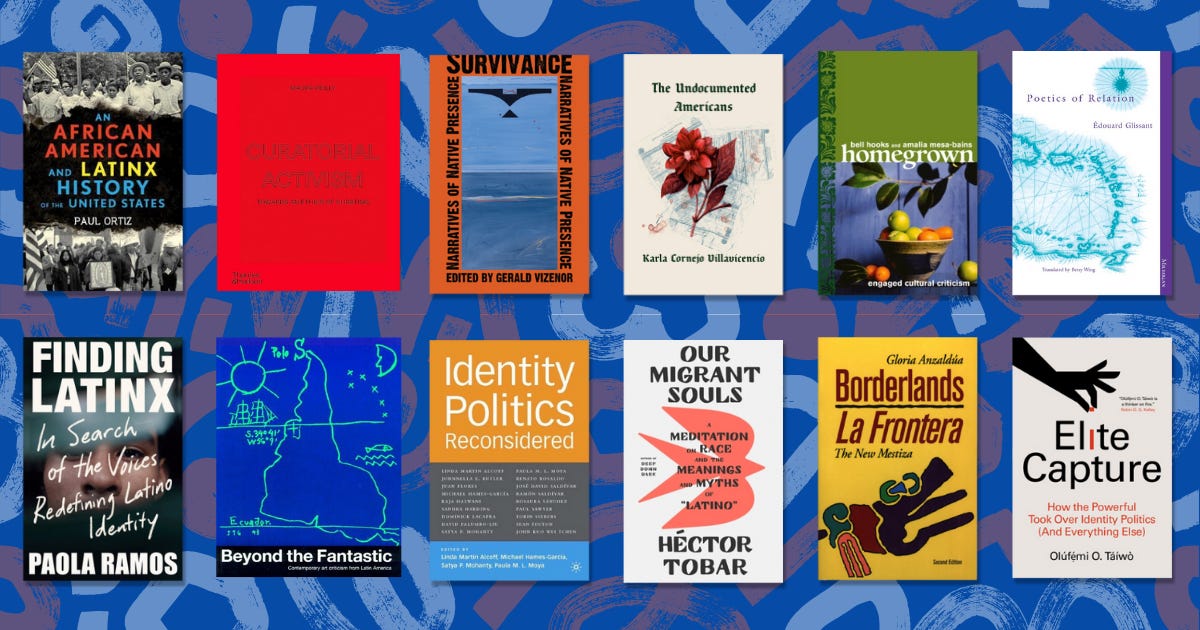
Popular press and crossover works translate these debates for wider publics in Ramo’s Finding Latinx documents intimate stories within Latine/x-American communities and self-naming practices;30 Cornejo Villavicencio’s The Undocumented Americans refuses extractive storytelling and embeds a deeply personal element of self-narrating personal experience and relationships built with those of whose accounts she shares;31 Tobar’s Our Migrant Souls interrogates racialization of the “Latino” in the United States;32 Ortiz’s An African American and Latinx History of the United States re-centers hemisphere solidarities and shows the interwoven histories of activism of hyphenated identities within the United States;33 Reilly’s Curatorial Activism offers a field guide to undoing representational gatekeeping.34 These popular press works of literature shape the tone of this thesis and its ethics as rigorous, accessible, and oriented toward community agency and authorship.
Táíwò’s Elite Capture urges us to build spaces and practices that retain community power rather than simply chasing recognition in elite arenas.35 Museum histories and the Western art historical canon warn how easy it is to drift back toward aesthetic capture by developing representations of Latin American and Latine/x art as “exotic” or laminated into preset narratives. By contrast, Interpreting Self codes anti-capture practices through shared authorship, consent, and narrative transparency. Digital exhibition infrastructures, in turn, lower the barriers of entry to anyone able to access the Internet. From data extraction to co-authorship, projects often harvest testimony, while curators still decide visual language. By materializing self-definition through visual language, we instead choose to model identity as doing and making, not only naming.
Section IV. The Research Gap
Scholarship on Latine/x-American identity in the United States has richness, but it is also uneven; sociological and developmental literature chart trajectories of acculturation and ethnic identity, while museum and art historical debates question how institutions frame Latin American and Latine/x-American art. Personal accounts of experience are weighted with emotional relevance, but they don’t fully connect data-driven processes. Institutional projects rarely let participants author both knowledge and representation, and often these feel like two separate entities instead of a complex and interconnected identity. Interpreting Self takes a step in a different direction by intentionally weaving together oral histories and co-authored portraiture, then exhibiting the results publicly, whilst routing its research in reparative methods. In doing so, this project advances four interlinked commitments: method as intervention, citation as repair, memory as resistance, and guarding against capture. We instead ask how these macro-structures touch the micro-textures of everyday life for generations of Latine/x-Americans, by developing the plurality of depiction.
The difficulties of finding research for this project were not a lack of abundance, but rather a lack of cohesion between all of the elements of the project being reflected in the research. Where one source developed a strong understanding of the data, another developed the emotional, and another the curatorial. Additionally, recent scholarship on the topic of Latine/x-American identity is lacking, and in turn, popular press publications are filling the gaps with more personal accounts. This is where Interpreting Self places itself within the gap, by developing a spectrum of understanding between these varied sectors. The inclusion of Latine/x-American voices is not simply additive; participants self-determine and author their own contexts. Our footnotes deliberately route attention to the Global South and center decolonial and activist practices as a method for academic authorship, artistic presence, and curatorial practice. Memory is operative as an engine of catharsis, agency, and resistance against erasure. This all culminates in a space of healing, while pushing for a more critical understanding of how all of these factors are part of larger systems that need to be questioned and deconstructed.
Furthermore, this project is informed by both academic and holistic methodologies, meaning it defines itself as a bridge between analysis of complex processes and the more emotionally charged and experiential markers that form identity. The oral accounts and co-authored portraits presented here are not separate from the research. In sharp contrast, there’s no delineation between where the experiential and the research begin and end, because this project acknowledges that both are dependent upon pieces tied together to form a larger whole. These systemic processes may begin at the top, but we are not singularly independent from them. Instead, we are all pieces within a larger structure that we all uphold, whether consciously or unconsciously. Therefore, when we define how we move through the world and understand our socio-cultural landscape, we cannot ignore the experiential within the larger narrative, as we cannot ignore the tangible results of these systems of experience, such as the policies and polemics of sensationalism, which continues to multiply within the United States. Compressing these multi-dimensional factors reduces a complex system into an inequitable two-dimensional space; black and white, them and us, normal and “other.” Systems of denial and injustices are created, scaffolded, and maintained, allowing for flattened concepts of identity, race, ethnicity, and gender, further giving allowances to rewrite history by separating the humanity from the human.
These are not new problems. Collectivity is often criticized and reduced within the West, but simultaneously, barriers and hierarchies are developed to keep certain communities apart from what is considered the standard or the norm. These barriers, in many cases, have stretched across generations and within identity studies, community archives, and curatorial debates. The through-line is clear: who speaks and how representations are made are inseparable from one another, transcending past a singular voice or identity. This is an ever-evolving and contextual study, and by situating this project in the intersection of knowledge and experience, it allows the flexibility for the research to evolve and make space for more dimensional landscapes of understanding.
Prior work powerfully maps identity development practices, generational dynamics, and institutional frames, but often stops at representation as an interwoven methodology. Interpreting Self remakes that pipeline by countering that Latine/x-American memory, identity, and experience, can be read not as demographic residue, but as an act of resistance, propose a politics of attention, and provide an existential space of being, which cannot be categorized under Cartesian knowledge. This body of work aims to be a space of coalescence for creativity, resilience of memory, and the empowerment of self-proclamation through an artistic lens and a public history practice.
A Note on Preservation: We believe the power of an oral history lies in the unique voice of the storyteller. To honor this, we have chosen to leave the grammar and flow of the oral history submissions exactly as they were received. Aside from correcting obvious and severe misspellings, no editorial changes have been made. Our goal is to protect the sanctity of the original writing and provide you with an unfiltered connection to the contributor’s experience.
Disclaimer: This work is written by humans for humans. No generative artificial intelligence (AI) was used in the writing of this work. The author expressly prohibits any entity from using this publication for purposes of AI technologies to generate text, including, without limitation, technologies that are capable of generating works in the same style or genre as this publication. The author reserves all rights to Interpreting Self: A Collection of Contemporary Oral Histories Exploring Generational Latine/x-American Identity & Narrative and its various interations and forms of publication, exhibition, and display.
To view more stories by Latine/x-Americans, please visit the Oral Histories page, which will have new stories posted regularly.
To share your story with this project, in which you can choose to remain anonymous, please visit the Share Your Story page.
To learn more about this project, please visit An Introduction.
To learn more about the sources of this project and the research gap it aims to bridge, please visit the Literature Review page.
© 2026 Joanna Arteaga Ferrin. All rights reserved.
Suzanne Oboler, “Approaches to Latino/a Identity Formation,” Latino Studies 7, no. 2 (June 2009), 165–66
T. Golash-Boza, “Dropping the Hyphen? Becoming Latino(a)-American through Racialized Assimilation,” Social Forces 85, no. 1 (September 1, 2006), 27–55.
Édouard Glissant, “For Opacity,” essay, in Poetics of Relation (London, UK: Penguin Books, 1990), 189–94.
Patricia M. King and Marcia B. Baxter Magolda, “A Developmental Model of Intercultural Maturity,” Journal of College Student Development 46, no. 6 (November 2005), 571–92.
Vasti Torres and Marcia B. Baxter Magolda, “Reconstructing Latino Identity: The Influence of Cognitive Development on the Ethnic Identity Process of Latino Students,” Journal of College Student Development 45, no. 3 (May 2004), 333–47.
Adrian J. Archuleta and Monica Lakhwani, “Balancing Cultures: Acculturation, Environmental Mastery, Emotional Regulation, and Depressive Symptoms among First-Generation Latino/a Youth,” Social Work in Mental Health 14, no. 3 (November 13, 2015), 271–91.
Stephanie R. Potochnick and Krista M. Perreira, “Depression and Anxiety among First-Generation Immigrant Latino Youth,” Journal of Nervous & Mental Disease 198, no. 7 (July 2010), 470–77.
Nancy S. Landale, Kevin J. Thomas, and Jennifer Van Hook, “The Living Arrangements of Children of Immigrants,” The Future of Children 21, no. 1 (March 2011), 43–70.
Melanie M. Domenech Rodriguez, Melissa R. Donovick, and Susan L. Crowley, “Parenting Styles in a Cultural Context: Observations of ‘Protective Parenting’ in First‐generation Latinos,” Family Process 48, no. 2 (May 19, 2009), 195–210.
Kathleen M. Roche et al., “Cultural Orientations, Parental Beliefs and Practices, and Latino Adolescents’ Autonomy and Independence,” Journal of Youth and Adolescence 43, no. 8 (June 29, 2013), 1389–1403.
Marta Benito-Gomez, “Understanding the Role of Parental Control in Early Childhood in the Context of U.S. Latino Families in the 21st Century,” Social Sciences 11, no. 3 (February 23, 2022).
“Generational Differences,” Pew Research Center, March 20, 2004, https://www.pewresearch.org/race-and-ethnicity/2004/03/19/generational-differences/#:~:text=race%20or%20ethnicity.-,Generation%20One%20and%20a%20Half,those%20born.
Ariana A. Curtis, “Afro-Latinidad in the Smithsonian’s African American Museum Spaces,” The Public Historian 40, no. 3 (August 1, 2018), 278–91.
Jennifer Scheper Hughes and Ariane Dalla Déa, “Authenticity and Resistance,” Latin American Perspectives 39, no. 2 (February 16, 2012), 5–10.
Tanya L. Saunders, “Black Thoughts, Black Activism,” Latin American Perspectives 39, no. 2 (December 1, 2011), 42–60.
Sofia A. Villenas, “Diaspora and the Anthropology of Latino Education: Challenges, Affinities, and Intersections,” Anthropology & Education Quarterly 38, no. 4 (December 2007), 419–25.
Christina Aushana, “Transborder Art Activism and the U.S.-Mexico Border: Analyzing ‘Artscapes’ as Forms of Resistance and Cultural Production in the Frame of Globalization,” The International Journal of Interdisciplinary Social Sciences: Annual Review 6, no. 7 (2012), 127–42.
Julio Cammarota, “The Gendered and Racialized Pathways of Latina and Latino Youth: Different Struggles, Different Resistances in the Urban Context,” Anthropology & Education Quarterly 35, no. 1 (March 2004), 53–74.
Veronica Vélez et al., “Battling for Human Rights and Social Justice: A Latina/o Critical Race Media Analysis of Latina/o Student Youth Activism in the Wake of 2006 Anti-Immigrant Sentiment,” Social Justice 35, no. 1 (2008), 7–27.
bell hooks and Amalia Mesa-Bains, Homegrown: Engaged Cultural Criticism (New York, NY: Routledge, Taylor & Francis Group, 2018).
Arlene Davila, “Latinizing Culture: Art, Museums, and the Politics of U.S. Multicultural Encompassment,” Cultural Anthropology 14, no. 2 (May 1999), 180–202.
Mari Carmen Ramírez, “ Beyond ‘The Fantastic’: Framing Identity in U.S. Exhibitions of Latin American Art,” Resisting Categories: Latin American and/or Latino, December 31, 2017, 917-35.
Ivan Muñiz-Reed, “Thoughts on Curatorial Practices in the Decolonial Turn,” On Curating: Decolonizing Art Institutions, no. 35 (December 2017), 99–105.
Oswald de Andrade, “Anthropophagite Manifesto,” Revista de Antropofagia, May 3, 1928, 20–23.
Joaquín Torres-García, “The School of the South Manifesto,” Essays on Latin American Art, 1935, 393–97.
Andrea Giunta, “Strategies of Modernity in Latin America,” essay, in Beyond the Fantastic: Crítica de Arte Contemporánea Desde América Latina (Granada, Spain: Universidad de Granada, 2022), 53–66.
Coco Fusco, “Introduction: Latin American Performance and the Reconquista of Civil Space,” essay, in Corpus Delecti: Performance Art of the Americas (London, UK: Routledge, 2000), 1–18.
Rafael Cardoso, “Decolonizing the Canon?,” Texte Zur Kunst 35, no. 128 (December 2022), 98–107.
Linda Martín. Alcoff and Satya P. Mohanty, “Reconsidering Identity Politics: An Introduction,” essay, in Identity Politics Reconsidered (New York, NY: Palgrave Macmillan, 2006), 1–9.
Paola Ramos, Finding Latinx: In Search of the Voices Redefining Latino Identity (New York: Vintage Books, a division of Penguin Random House LLC, 2020).
Karla Cornejo Villavicencio, The Undocumented Americans (New York: One World, 2021).
Hector Tobar, Our Migrant Souls: A Meditation on Race and the Meanings and Myths of “Latino” (New York, NY: Farrar, Straus and Giroux, 2023).
Paul Ortiz, An African American and Latinx History of the United States (Boston, MA: Beacon Press, 2018).
Maura Reilly and Lucy R. Lippard, Curatorial Activism: Towards an Ethics of Curating (New York, NY: Thames & Hudson, 2021).
Olúfẹmi O. Táíwò, Elite Capture: How the Powerful Took over Identity Politics (and Everything Else) (London, UK: Pluto Press, 2022).