
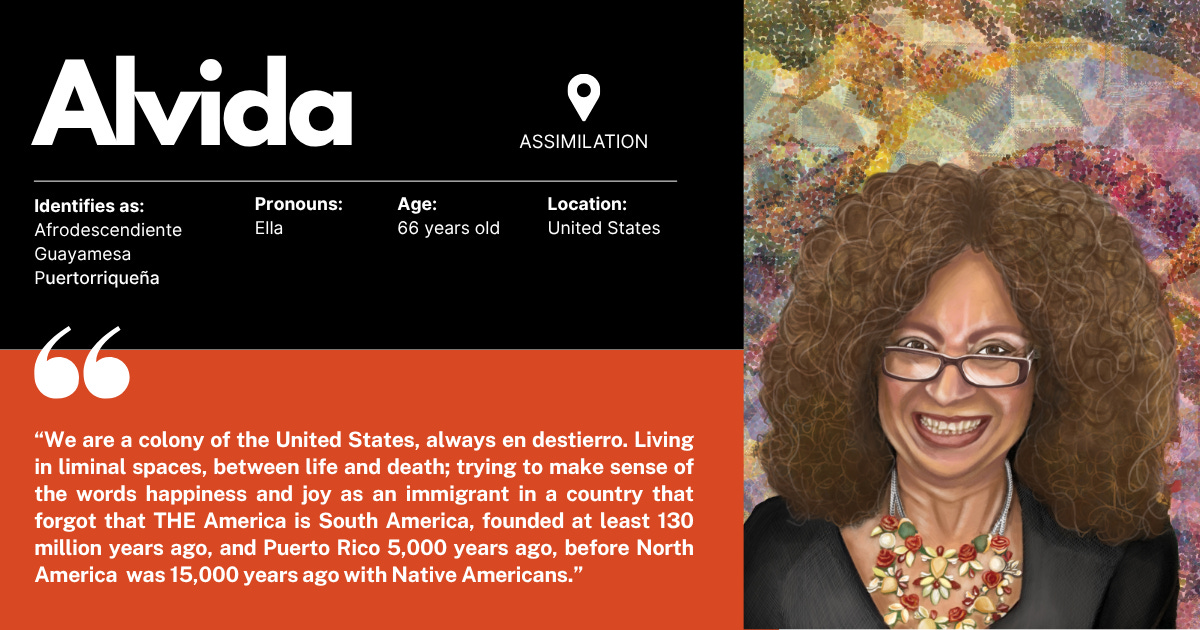
"Living in liminal spaces, between life and death; trying to make sense of the words happiness and joy as an immigrant in a country that forgot..."
Meet Alvida (Ella) an Afrodescendiente, Guayamesa, Puertorriqueña. She shares her experience of how assimilation impacted her identity.
A Note on Preservation: We believe the power of an oral history lies in the unique voice of the storyteller. To honor this, we have chosen to leave the grammar and flow of these submissions exactly as they were received. Aside from correcting obvious and severe misspellings, no editorial changes have been made. Our goal is to protect the sanctity of the original writing and provide you with an unfiltered connection to the contributor’s experience.
A Note on Opinions: The views and opinions expressed in this story are those of the speakers and do not necessarily reflect the views or positions of any entities. These are human stories from differing perspectives and experiences. As the reader, you have the right to disagree with the views and opinions expressed. This project is focused on shared humanity, the power of memory, and creating a space of healing and agency for participants.
“In my Puerto Rican línea materna we kept going back to Puerto Rico to give birth while living, for three generations, between New York and Guayama, PR. We are a colony of the United States, always en destierro. Living in liminal spaces, between life and death; trying to make sense of the words happiness and joy as an immigrant in a country that forgot that THE America is South América, founded at least 130 million years ago, and Puerto Rico 5,000 years ago, before North America was built 15,000 years ago with Native Americans.
My point is that we are dismissed, erased, betrayed, assaulted, dumbed down, burned from our homes, bullied and bulldozed, called rapists, stupid people, pigs who are dirty, and thieves. I had always struggled with writing from my psychological, and social, cultural linguistic shifts center. That was true until March 8 of this year. Now I am a storm, organizing women writers and trying to fundraise $50,000 so that 10-12 Latina women can write cómo les plazca, bajo ‘ALviLda Sophia Anaya - Alegría y Su Junte de Escritoras Literarias.’
It is this time, to liberate our inner-land, non fiction characters, como hace Alejandro González Iñárritu (película Bardo de ejemplo), cortando bruscamente escenas, hablando de otros temas en una misma conversación, interrumpiéndonos y abrazándonos en esos espacios metafísicos; NOLINEALES.
The memory that brings me the most joy is to have been born, lived, played, gone to the Universidad in Guayama, Puerto Rico, and made friends. BEING CRADLED by the Caribbean wind, water, sand, burning sun, and crystals caressing mi piel also mattered. Understanding that we are a culture with great African and Taína lineage, with soooo many Goddesses, is still a bliss of safeguarding when I feel unwelcome in any North American state. Otherwise, I wouldn’t know what it is to feel loved by the many arms and hugs I would’ve liked.
Sigh. Deep breath here.
Joy and pain sit together. When I am constantly told that my writing is not clear enough, it literally goes with seeing the mean, cruel, intimidating gaze of white men.
Imperialism. Slaughter. War. Children’s cages. Genocide. People of Color prisons. Rape of women and girls. African slavery and lynching.
Cada cual por su casa.
Ufff.”
Disclaimer: This work is written by humans for humans. No generative artificial intelligence (AI) was used in the writing of this work. The author expressly prohibits any entity from using this publication for purposes of AI technologies to generate text, including, without limitation, technologies that are capable of generating works in the same style or genre as this publication. The author reserves all rights to Interpreting Self: A Collection of Contemporary Oral Histories Exploring Generational Latine/x-American Identity & Narrative and its various interations and forms of publication, exhibition, and display.
To view more stories by Latine/x-Americans, please visit the Oral Histories page, which will have new stories posted regularly.
To share your story with this project, in which you can choose to remain anonymous, please visit the Share Your Story page.
To learn more about this project, please visit An Introduction.
To learn more about the sources of this project and the research gap it aims to bridge, please visit the Literature Review page.
© 2026 Joanna Arteaga Ferrin. All rights reserved.