
"There’s an empty space there where a family story should be..."
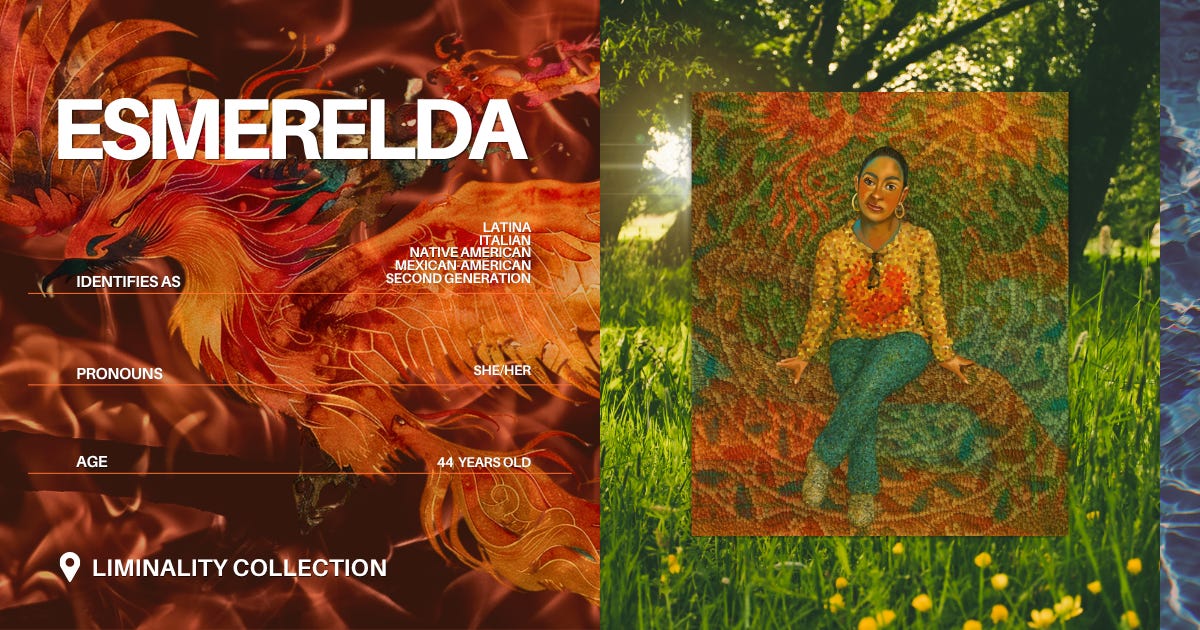
Meet Esmerelda (She/Her) a second generation Latina who is learning more about her identity, and navigating through liminal spaces in society.
A Note on Preservation: We believe the power of an oral history lies in the unique voice of the storyteller. To honor this, we have chosen to leave the grammar and flow of these submissions exactly as they were received. Aside from correcting obvious and severe misspellings, no editorial changes have been made. Our goal is to protect the sanctity of the original writing and provide you with an unfiltered connection to the contributor’s experience.
A Note on Opinions: The views and opinions expressed in this story are those of the speakers and do not necessarily reflect the views or positions of any entities. These are human stories from differing perspectives and experiences. As the reader, you have the right to disagree with the views and opinions expressed. This project is focused on shared humanity, the power of memory, and creating a space of healing and agency for participants.
“I am second gen, as my grandparents were immigrants from Italy and Mexico. I grew up knowing myself as a Native American female. I married into a Mexican family very young, I was 14, and I was always immersed in Mexican culture.
Because I believed I wasn’t Mexican, I was always cautious not to ‘appropriate’ or ‘act’ like something I knew I was not. At the same time, I felt super comfortable with the culture. It fit me in a way I couldn’t really explain.
I didn’t find out I was actually Mexican and Italian until 2020. Now that it’s confirmed I am in fact Mexican, I’m struggling with how to be Mexican in front of people who knew me before I knew. I feel torn between adopting what’s always felt natural and feeling like a fake.
One of the few times in my life that I truly felt a part of something was when I visited Tepatitlán, Mexico. I just felt at home. It was an amazing trip, and the people of the town were so welcoming, it felt like family. As a former foster youth, that sense of belonging was rare and powerful.
There have also been painful moments connected to identity. My ex-husband’s family judged me harshly for not being Mexican. They treated me and my children horribly because we ‘weren’t Mexican’ and didn’t speak Spanish perfectly. Now, knowing I actually am Mexican by heritage makes all of that even more complicated inside me.
I don’t know the story of my grandparents’ migration. Because I’m not sure what it is, I also don’t really know how it has impacted me. There’s an empty space there where a family story should be.
What I do know is how I feel about where I live now. I do wish I didn’t have to live in the United States in the current climate of this country. If I could choose, I would definitely choose to move to Mexico or Italy.”
Favorite Quote
Don't be the best in the world. Be the best for the world. — Dewitt Jones
Disclaimer: This work is written by humans for humans. No generative artificial intelligence (AI) was used in the writing of this work. The author expressly prohibits any entity from using this publication for purposes of AI technologies to generate text, including, without limitation, technologies that are capable of generating works in the same style or genre as this publication. The author reserves all rights to Interpreting Self: A Collection of Contemporary Oral Histories Exploring Generational Latine/x-American Identity & Narrative and its various interations and forms of publication, exhibition, and display.
To view more stories by Latine/x-Americans, please visit the Oral Histories page, which will have new stories posted regularly.
To share your story with this project, in which you can choose to remain anonymous, please visit the Share Your Story page.
To learn more about this project, please visit An Introduction.
To learn more about the sources of this project and the research gap it aims to bridge, please visit the Literature Review page.
© 2026 Joanna Arteaga Ferrin. All rights reserved.